Press release · Long read
We make the only whole blood leukoreduction filter in the world without organic solvents or wastewater.
CellNet™ PR · Every batch
The footprint inside the filter
Transfusion medicine is starting to measure its carbon cost. The one number the ledger keeps leaving out is how the filter itself is made. We think that is the next thing worth changing.
In brief
- A 2024 life-cycle study put one red cell transfusion in England at 7.56 kg CO₂e. How the filter inside the pack was made is not itemized.
- Conventional filter media are treated with organic solvents and process water. CellNet™ media is modified with patented supercritical CO₂ instead: no solvents, zero process water.
- Nothing was traded away: fewer than 0.3×10⁶ residual white cells, red cell recovery above 92%, and 98–100% platelet removal.
Taipei, Taiwan, November 17, 2026. For thirty years, the leukocyte filter was treated as a solved problem. It removes white cells from donated blood, it meets the standard, and the industry moved on. The filter worked, so the question of how it is made was treated as finished too.
It is not finished. And the gap between how well these filters perform and how cleanly they are produced is wider than almost anyone realizes.
This is a long read about a small part. A single-use filter the size of your palm, made by the tens of millions every year, sitting quietly inside nearly every bag of donated blood in the developed world. It is one of the great unremarked successes of modern transfusion safety. It is also carrying an environmental cost that no one has been counting. Here is where that cost comes from, why it stays invisible, and what we did about it.
01How a filter gets its surface
Start with the fiber, because everything follows from it.
A leukoreduction filter is, at its heart, a mat of fine nonwoven polymer fiber. On its own, that fiber does not do the delicate work of letting red cells through while holding white cells back. It has to be given new surface properties first, so that the physics of wettability and surface charge do the sorting. How you give the fiber those properties is the entire craft of the filter.
For three decades, the commercial answer has been wet chemistry. You take a hydrophilic agent, you dissolve it in an organic solvent such as ethanol, acetone or tert-butanol, you apply it to the fiber by coating or grafting, and then you wash the excess away. It is a mature, well-understood, effective process. It is also, by its nature, a wet one.
- 01DissolveHydrophilic agent in ethanol, acetone or tert-butanol
- 02ApplyCoat or graft onto the fiber
- 03WashRinse the excess away
- 04DryDrive off solvent and water
None of that is a scandal. It is simply how the industry grew up, at a time when no one was asked to account for the solvent in the tank or the water down the drain. The filters got better and better. The way of making them stayed the same.
02The number that is missing
In 2024, the journal Transfusion published something the field had never had: a full life-cycle assessment of a red cell transfusion, measured across the blood service of an entire country. The headline figure was 7.56 kg of CO₂ equivalent per unit transfused in England and, scaled up, on the order of ten million kilograms of CO₂ equivalent a year for red cells alone.
It is a landmark study, and an overdue one. It counted transport. It counted the refrigeration that runs around the clock. It counted the plastic of the blood pack as a material. It did not, because almost no study yet does, count how the filter inside that pack was manufactured.
- Transportation2.80
- Hospital transfusion processes1.90
- Donation1.30
- All other stages1.56
- Total per unit7.56
- How the filter in the pack was made: solvents, process water, wastewaterNot itemized
Central estimate. About 10.3 million kg CO₂e a year for red cells across England. Hibbs et al., Transfusion, 2024.
That is the pattern worth naming. When healthcare talks about the environmental cost of a transfusion, it tends to count the device as waste at the end of its life. It rarely counts the solvents and the wastewater that went into making the device at the start of its life. The manufacturing footprint sits upstream, in a factory, often in another country, long before a unit of blood is ever collected. It is out of sight, and so it stays out of the ledger.
Now put scale against it. The World Health Organization counts about 120 million blood donations collected worldwide each year. Across the high-income blood services where leukoreduction is standard practice, from the United States, where more than 95% of units are leukoreduced, to Canada, Japan and much of Europe, nearly every one of those units passes through a single-use leukocyte filter. That places global filter production in the tens of millions of units a year, each one, under the conventional method, carrying its small share of solvent and wastewater.
Small, multiplied by tens of millions, stops being small.
03Why your biggest footprint is in your suppliers
There is a reason this matters now, beyond good intentions, and it is written into the way organizations are being asked to report.
For most institutions, the largest part of the carbon footprint is not in their own buildings and vehicles. It is in their supply chain, the goods and services they buy. Analyses by CDP and the Boston Consulting Group have put corporate supply-chain, or Scope 3, emissions at around 26 times operational emissions on average. In healthcare specifically, work by Health Care Without Harm and Arup found that about 71% of the sector’s climate footprint comes from its supply chain. Healthcare itself accounts for roughly 4.4% of global net greenhouse gas emissions.
Reporting frameworks are catching up to that reality. The IFRS S2 climate-disclosure standard brings Scope 3 into the picture. And the practical problem every disclosure team runs into is the same: supply-chain numbers are mostly estimates, built from industry averages, because a spend-based average cannot tell one supplier’s filter from another’s.
That is exactly where a measured, supplier-specific improvement becomes valuable. If the filter you buy is made without solvents and without process water, that is not a rounding error in an average. It is a real, attributable reduction in the part of your footprint that is hardest to move. For CellNet™ media, that reduction is more than 90% less process carbon at the media processing stage, 7.68 kg CO₂e per kg of media against 83.2 kg for conventional wet modification, with 0 L of process water. The data is in our supplier sustainability data pack, available on request.
04Water, the other half of the story
Carbon gets the attention, but the wet-chemistry route has a second cost that is easy to forget: water.
The dissolve-apply-rinse approach uses water to carry, to wash and to treat. The textile industry, which hydrophilizes fibers by the same wet-chemistry logic, is one of the most visible examples of what that adds up to at scale; by some estimates the dyeing and finishing of textiles accounts for close to a fifth of global industrial water pollution. Filter media are produced on a far smaller scale than textiles, but by the same underlying method, with the same need for process water and the same wastewater to treat afterwards.
When we talk about our own process, the water figure is not a percentage reduction. It is zero. No coating bath, no rinse, no process wastewater to treat.
- 0Organic solventsNo solvent in the tank
- 0Process waterNot reduced, not recycled
- 0Process wastewaterNothing to treat
>90%Less process carbon7.68 kg CO₂e per kg of media, against 83.2 kg for conventional wet modification. Media processing stage, gate-to-gate; Sangtech’s own calculation.
05We went back to the fiber
CellNet™ PR is made differently, and we are deliberately guarded about exactly how, because the method is the heart of the company.
What we can say is this. Instead of dissolving the surface treatment in organic solvents, we process our proprietary filtration media through a patented supercritical-CO₂ process, protected under U.S. Patent No. 11,224,686 B2. The media is treated in a closed system, and the carbon dioxide is captured and reused, batch after batch, rather than released to the air or sent to a drain.
- 01Media inOur proprietary filtration media
- 02ModifyPatented supercritical CO₂ process
- 03Media outReady for the filter, nothing to rinse
- No organic solvents
- Zero process waterNot reduced, not recycled. None.
- CO₂ recovered and reusedIn a closed loop
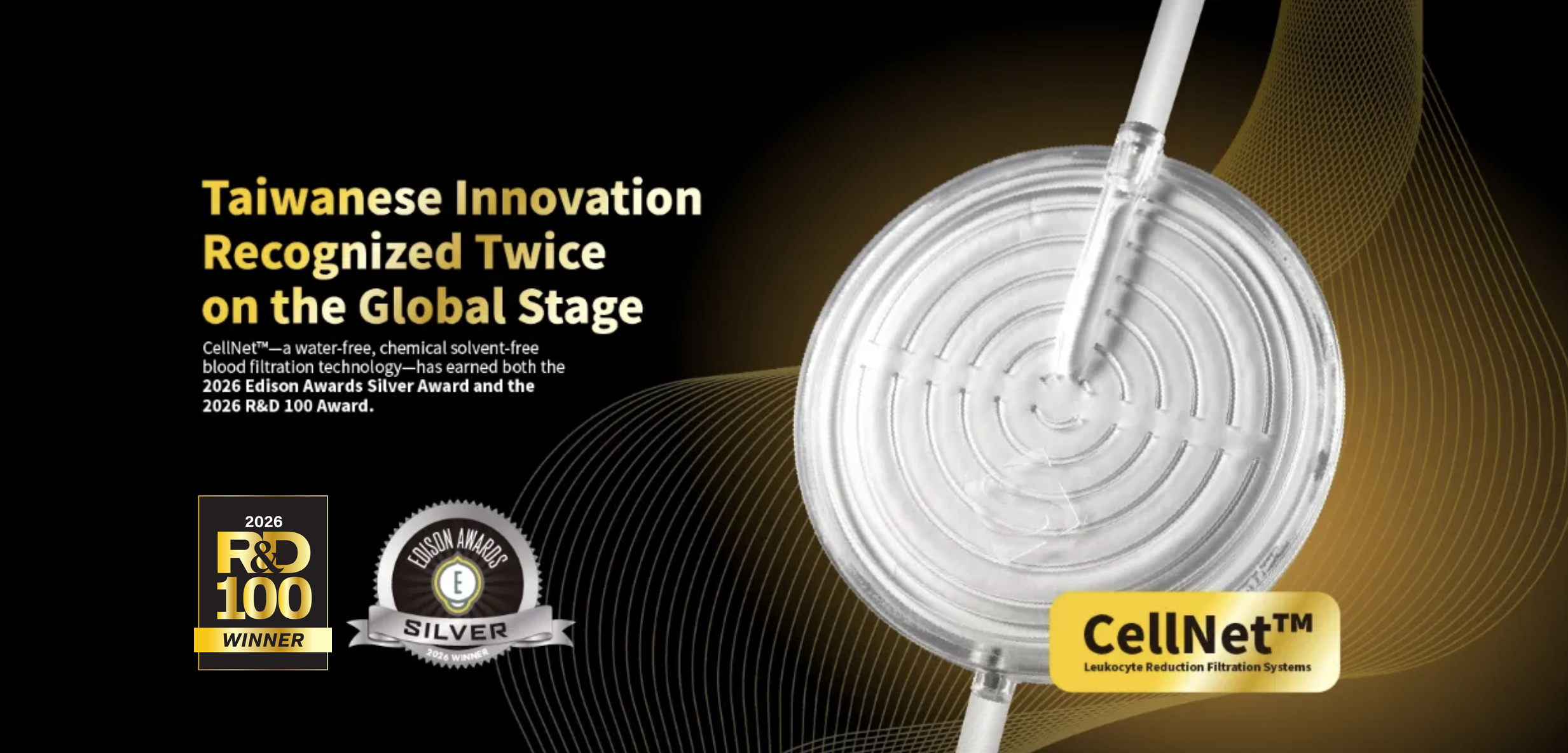
That is how we make the only whole blood leukoreduction filter in the world without organic solvents or wastewater, batch after batch, today. We stand behind that claim, and behind the invitation that comes with it: if another manufacturer can document an equivalent process, we would like to see it. Until then, that is where CellNet™ PR stands, and it is the work that has been recognized this year. Both award records independently describe the process as solvent-free and water-free.
 Edison Awards 2026Silver · Energy and Climate Resiliency
 R&D 100 Awards 2026Developed by Sangtech; joint work with the Taiwan Textile Research Institute
06Nothing was traded away
A cleaner process would be a footnote if it made a worse filter. It does not, and that is the part we are proudest of.
- 0
- 1
- 2
- 3
- 4
Platelets are taken out of the red cells and plasma cleanly, rather than ruptured and left to release their contents back into the very components the filter is meant to protect. And there is a quiet logic to the cytotoxicity result: a process that never uses solvents has none to leave behind.
Top-tier filtration and a process with no organic solvents and no process water, in the same filter. Not a trade-off between them, which is the assumption we set out to break.
07A cleaner material, inside and out
The same thinking runs through the materials. CellNet™ PR is offered with zero-DEHP housing, in both hard and soft casing formats, and DEHP-free media. DEHP is a phthalate plasticizer long used in PVC medical components; it can migrate into blood during storage and transfusion, and the European Union has set a 2030 sunset for its use in medical devices.
Taking it out of both the housing and the media means the clean process is matched by a clean material, which is increasingly what blood services and their regulators are asking for.
08The upstream bet
A word on what we are, because it shapes everything above. We are a materials company. We make filter media and semi-finished filters, and we supply them to the device manufacturers who build the finished collection systems used in blood centers. The process and the performance are ours; the finished device, its regulatory clearance and its labeling belong to the manufacturers who integrate our media.
That is a deliberate place to stand. The largest reductions available to healthcare are upstream, in the components that everything else is built from. A leukoreduction filter is one of the most widely produced single-use parts in all of transfusion medicine. Change how that one part is made, and the benefit does not stay with us. It carries into every product built on top of it, and into the footprint of every service that uses them.
“For thirty years the leukocyte filter was treated as a solved problem. We did not accept that. We went back to how the filter is actually made, and it turns out you can take out the solvents and the water and end up with a better filter, not a worse one. CellNet™ is not one product. It is a cleaner way to make a whole category of them, and that is the direction this industry has to go.”
Tyler McConville, Deputy CEO, Sangtech Lab Inc.
09What is next
Measuring the carbon of a transfusion was the right first step, and the people who did it deserve credit for starting a conversation the field had avoided. The next step is to widen the lens: to count the whole device, including how it was made, and to give the blood services who buy it a cleaner option when they do.
We started with the filter.We went back to the fiber.We are not done.
Hibbs SP, Thomas S, Agarwal N, et al. What is the environmental impact of a blood transfusion? A life cycle assessment of transfusion services across England. Transfusion. 2024. doi:10.1111/trf.17786
View source (opens in a new tab)World Health Organization. Blood safety and availability, fact sheet.
View source (opens in a new tab)CDP and Boston Consulting Group. Scope 3 Upstream: Big Challenges, Simple Remedies. June 2024.
View source (opens in a new tab)Health Care Without Harm and Arup. Health care’s climate footprint. September 2019.
View source (opens in a new tab)Ellen MacArthur Foundation. A New Textiles Economy: Redesigning Fashion’s Future. 2017.
See all sourcesSangtech Lab Inc. Filter material and manufacturing method thereof. U.S. Patent No. 11,224,686 B2. January 18, 2022.
View source (opens in a new tab)Commission Regulation (EU) 2023/2482, amending Annex XIV to REACH (DEHP in medical devices).
View source (opens in a new tab)